Natural History & Biology Almanac

Nature Has Its Reasons

When a woodland seed pod launches itself like a spring-loaded catapult or a forest berry glimmers intensely for decades after drying out, the cause is rarely decorative accident. In the field, unusual biological traits almost always answer a specific physical problem: conserving metabolic energy, dispersing spores through still air, or surviving winter freezes without rupturing cells.

01
01 — Structural optics without pigment

The African berry that shines brighter than any flower without a drop of dye
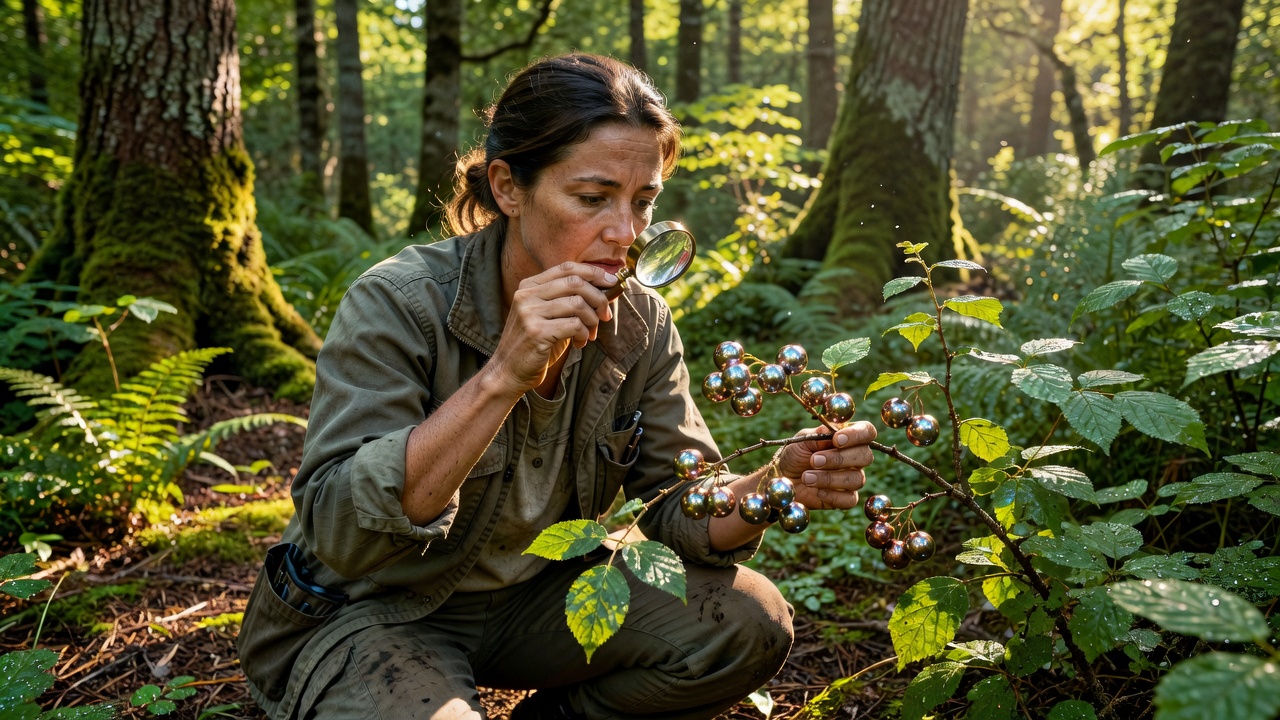
Field biologist holding a hand lens up to metallic berries in sunlit woodland foliage
Plant Physics

Most fruits attract seed-dispersing birds by packing their skins with sugars and chemical pigments like anthocyanins or carotenoids. Yet the marble berry (Pollia condensata), native to forest understories across East and West Africa, produces virtually no nutritional pulp and zero pigment in its outer epicarp. Even so, herbarium specimens collected in Ghana in 1974 still gleam on museum shelves today with the same metallic intensity they had fifty years ago.

In 2012, physicists and plant biologists at the University of Cambridge examined the fruit's hull under an electron microscope. They discovered that the cell walls contain cellulose microfibrils stacked in helicoidal spirals. Each layer is spaced to match specific wavelengths of visible light, causing constructive interference—the exact optical principle that gives beetles and peacock feathers their shimmer. Because the hull contains no fading chemical dye, birds collect the durable berries to decorate courtship nests, dispersing the seeds for free without the plant investing energy in fruit flesh.
Traceable Source: Silvia Vignolini et al., "Pointillist structural color in Pollia fruit," Proceedings of the National Academy of Sciences, Vol. 109, No. 39 (2012), verified with Royal Botanic Gardens, Kew herbarium specimens.
02
02 — Subterranean acoustics

Why the mole cricket carves a double-exponential horn out of damp earth

Bioacoustics

A male European mole cricket (Gryllotalpa vineae) measures barely four centimeters long, and its wings are tiny compared to the wavelength of the low-frequency courtship song it needs to project across a meadow. Calling out in the open air causes acoustic short-circuiting, where pressure waves on the front and back of the wing cancel each other out.

To overcome this physical handicap, the insect spends hours sculpting and smoothing a Y-shaped earthen burrow with two flared surface openings. Bioacoustic casts prepared by physicist Henry Bennet-Clark revealed that the burrow throat functions as an acoustic transformer—matching the high mechanical impedance of the cricket's tiny wings to the low impedance of the outside air. Measured one meter away, the tiny burrow amplifies the insect's call to 92 decibels, audible to humans 600 meters down the valley.

Just like a brass tuba or a vintage gramophone horn, the mole cricket positions its wings precisely at the narrow junction between a closed subterranean bulb and the twin exponential flares, raising its sound conversion efficiency from less than 1 percent in open air to over 30 percent inside the soil horn.

Traceable Source: H. C. Bennet-Clark, "The Mechanism and Efficiency of Sound Production in Mole Crickets," Journal of Experimental Biology, Vol. 52 (1970).
03
03 — Botanical thermogenesis

The woodland cabbage that melts its own way through March snowdrifts

Plant Physiology

We normally think of plants as cold-blooded organisms that passively match the temperature of the surrounding air. Yet eastern skunk cabbage (Symplocarpus foetidus), growing in frozen wetlands across North America and Northeast Asia, blooms while snow still blankets the ground. Even when ambient night temperatures plunge to −15 °C, the plant's hooded spadix maintains an internal temperature between 15 °C and 22 °C for up to two weeks.

It achieves this by switching its cellular respiration to an alternative oxidase pathway in its mitochondria, burning starch reserves extracted from its thick root system at a metabolic rate comparable to a small hummingbird or shrew. The warmth melts a chimney straight through frozen snow and vaporizes sulfurous scent compounds to guide early-emerging carrion beetles and bees into a warm shelter.

Traceable Source: Knut Schmidt-Nielsen, Animal Physiology: Adaptation and Environment, and Roger S. Seymour, " Biophysics and physiology of temperature regulation in thermogenic flowers," Bioscience Reports (2001).
04
04 — Cryobiology in the leaf litter

How the North American wood frog freezes solid and restarts its heart in spring

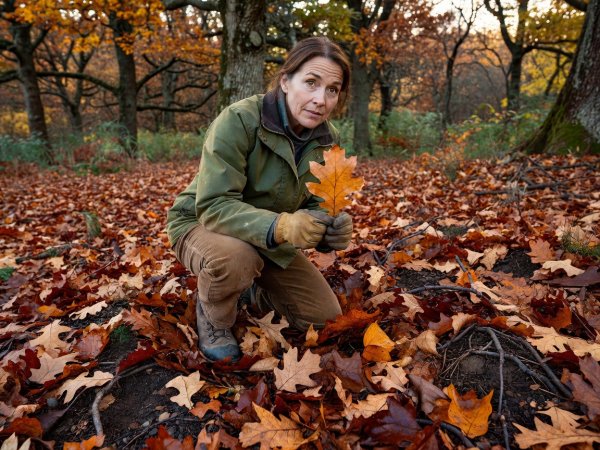
Biologist kneeling in autumn oak leaf litter examining woodland habitat in natural light
Cryobiology

If ice crystals form inside a typical vertebrate cell, their sharp edges pierce the cell membrane and draw water out until the tissue shrivels and dies. Yet the wood frog (Lithobates sylvaticus), which ranges from Georgia all the way north of the Arctic Circle in Alaska, winters just beneath dry oak leaves where temperatures drop well below freezing.

As the very first ice crystals touch its skin, the frog's liver rapidly converts glycogen reserves into massive quantities of glucose, raising blood sugar levels more than 100-fold. The water outside its cells freezes into solid ice—up to 65 percent of the frog's total body water turns solid, its heartbeat stops, and breathing ceases for weeks—while the thick syrup of glucose and urea inside each individual cell acts as a biological antifreeze, preventing internal ice formation until spring thaw.

Traceable Source: Kenneth B. Storey and Janet M. Storey, "Natural Freeze Tolerance in Ectothermic Vertebrates," Annual Review of Physiology, Vol. 54 (1992).

Curious how human engineers borrowed ideas from natural structures? Continue the chain to How Ideas Became Inventions →